WaveAssist
Published on: Apr 24, 2026
TL;DR. Your engineers ship the most precise documentation possible every single week: the code itself. The problem was never that engineers don't document. It's that nobody outside engineering could read code. AI just changed that. GitDigest reads the actual diffs your team shipped (not just the commit messages) and turns them into a digest each team (sales, support, exec, product) can actually use, every Monday.
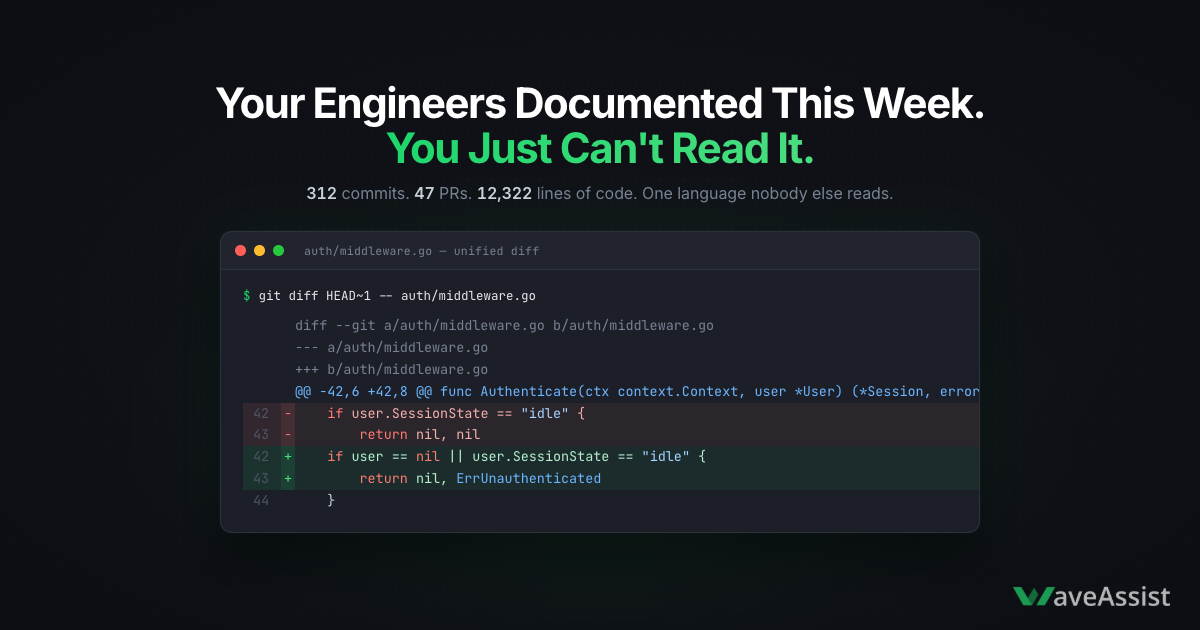
Your engineering team made 312 commits last week, across 47 pull requests, touching 18 services. The CEO couldn't tell you what any of it does. Sales is still demoing last quarter's roadmap. Product's standup hasn't mentioned a real work item in three weeks.
The gap isn't that engineers aren't documenting. They documented 312 times.
The gap is that nobody else in your company can read what they wrote.
"Engineers don't document" was the most repeated myth in software. AI just turned it backwards.
Engineers ship the most precise documentation possible every single day: the code itself. A diff is the unambiguous record of what changed, why a feature works, which edge case got handled. Commit messages and PR descriptions are summaries. The code is the source of truth. A team of ten engineers ships thousands of lines of this every week, authored, timestamped, linked, and reviewable.
The documentation was never missing. It was just unreadable to anyone who didn't write code for a living. What changed is that AI can finally read code and explain it in plain English. The reader showed up.
The diffs your team shipped this week already tell you, without asking anyone:
Every one of those signals is sitting in the code your team shipped. No engineer has to write one extra sentence. The work of documentation happened the moment the code was committed.
Same git history. Five different lenses. Nobody has time to read the commit log five times through five different filters, so in practice nobody reads it at all, and each team finds out when a customer complains.
Release notes are for customers, and by the time you're writing them it's already late.
GitDigest works one layer earlier, at the commit level: what the team is building, not what just shipped. A commit happens when the work is done, days or weeks before it reaches production. That lead time is the whole point.
By the time something ships:
Commit level visibility gives you that lead time. Release level visibility gives you surprise.
GitDigest runs every Monday at 9am. It reads the actual code your team shipped (the diffs themselves, not just the commit messages and PR titles) and writes five distinct digests:
Each one lands in the right Slack channel or inbox.
Same shape. Same day. Every week. It doesn't skip a week because someone was on PTO. It doesn't forget the quiet infrastructure commits that turn out to matter. It doesn't need the VP of engineering carving out Friday afternoons writing a weekly update nobody reads anyway.
The work of documentation was already done, 312 times, in code. GitDigest is the translator, not the author.
See what a digest actually looks like: Sample GitDigest report (PDF).
Your engineers don't need to write another weekly update. They already wrote it, 312 times this week, in code.
You just needed something to read it for you.
Deploy in one click. $2 free credits, no credit card needed.
Deploy GitDigest FreeBrowse All AssistantsDeploy this assistant in one click and let it run on autopilot while you focus on what matters. Get started with $2 in free credits, no credit card needed.